
The goal of the implementation was to automate 24/7 customer consultations and order processing across all digital channels while providing multilingual support. Binom Seller was designed to independently recommend products, handle customer objections, and perform upselling, transferring data to the CRM and involving a live agent only when necessary.
The company sells household chemicals through online stores in several countries. The product range, prices, currencies, stock availability, delivery terms, and contact details differ from country to country. At the same time, the brand, core product information, customer communication rules, answers to frequently asked questions, and objection-handling principles remain shared across the whole company.
The company needed to hand over the day-to-day function of communicating with online store customers to Binom Seller.
The synthetic employee needed to:
At the same time, the company needed to retain full control over every conversation and manage Binom Seller’s work through a single dashboard.
average time to first response — under 15 seconds; increase in average conversation depth from 2 to 7 messages; upsell growth from 11% to 35%; 17% increase in average order value.
The company chose Binom Seller — a synthetic salesperson trained on information about the company, the brand, the products, sales rules, customers’ frequently asked questions, and objection handling.
Binom Seller gained the ability to:
A priority language is set separately for each Binom. Binom opens the greeting in that language. After the customer’s first message, it continues the conversation in the customer’s language.
A branded support widget was installed on the online store’s website, offering text, voice messages, and voice communication.
The widget was configured with:
Binom Seller is available not only in the store’s general chat window, but also directly on product pages.
A customer can open a conversation on a specific product page and immediately ask about its properties, use, availability, price, or delivery.
A WebRTC module was connected on the website.
It lets the customer talk to Binom Seller by voice directly on the website in real time.
During the conversation, Binom Seller can:
This kind of communication works like a direct conversation with a sales consultant, without needing to install an additional app or make a phone call.
The online store’s catalog was connected through Google Merchant Feed.
Binom Seller receives up-to-date information from the product feed:
Whenever the information in the Google Merchant Feed is updated, Binom Seller starts using the updated data. This means there is no need to manually upload new price lists every time a price or stock level changes.
For stores that don’t use Google Merchant Feed, the catalog can be connected via XML, CSV, or another agreed data format.
Binom Seller was integrated with the company’s CRM.
The integration allows it to:
Every conversation is saved and can be linked to the corresponding customer in the CRM.
A dedicated Telegram bot was connected for customers.
Through it, a customer can:
Binom Seller uses the same information about the company and its products in Telegram as it does in the online store’s widget.
A separate Telegram bot was connected for company employee notifications.
The company decides for itself which notifications it needs to receive. For example:
The employee Telegram bot is not used to communicate with customers. Its purpose is to keep the team promptly informed about Binom Seller’s work.
Binom Seller was connected to the company’s Facebook Messenger and Instagram.
Customers can ask questions about products and place orders through the brand’s social media pages.
Regardless of the communication channel, Binom Seller uses a single knowledge base and up-to-date product information.
The synthetic employee’s work is managed through the Binom dashboard.
The company can:
Turning off the AI in one conversation does not stop Binom Seller’s work with other customers.
The company operates several online stores in different countries.
A separate Binom Seller was created for each country.
This is necessary because the following can differ from country to country:
For example, Binom Seller for Spain, Poland, and Ukraine are separate synthetic employees.
Each of them works with its own product feed, its own prices, its own currency, and its own local settings.
Despite being split by country, all instances of Binom Seller operate in the company’s shared knowledge space.
Shared information that can be passed between them includes:
Useful information can be passed to other instances of Binom automatically or after review by a moderator.
For example, if Binom Seller in Poland receives a new frequently asked question and a correct answer is worked out for it, that answer can be passed on to Binom Seller in Spain and Ukraine.
Meanwhile, local information — prices, currency, contacts, availability, and delivery — stays separate for each country.
Shared information can be passed between Binom instances through the Documents and Cards sections.
Documents. The Documents section stores uploaded company documents and materials. Documents can be shared with another Binom so the same information doesn’t need to be uploaded twice.
Cards. The Cards section stores individual knowledge cards. They are used for:
If information in a card conflicts with the text of an uploaded document, the card takes priority.
Cards can also be shared between multiple Binom instances.
All Binom instances belong to the client company.
At the same time, employees of local divisions only get access to the Binom instances they are responsible for.
For example:
An administrator or account owner can manage all of the company’s Binom instances.
Through the Teams section, the company can assign:
After implementation, the company gained a unified system for working with customers across all major digital channels.
Binom Seller:
At the same time, the company retains access to conversations, manages knowledge, controls the quality of answers, and defines employee permissions.
Creating Binom Seller requires no programming knowledge or AI experience. The core information is provided through a conversation with Binom Tutor. Fully preparing the first Binom Seller takes about 30 minutes when done in sequence.
Before you start, it’s useful to have: a link to the company website; a link to the online store; a company presentation; a description of the business; links to social media; documents with information about the company; a logo; brand colors; the product catalog; a link to Google Merchant Feed, XML, or CSV; a list of employees who will need access; the CRM and other systems’ data that need to be connected; a bank card to set up the subscription with the trial version; readiness to pay $75/month after the free period.
You don’t have to prepare everything in advance. Any missing information can be added later through Binom Tutor.
Create a company account in Binom AI. After registration, the Binom Tutor window opens. Binom Tutor helps you create, train, and configure your synthetic employee through an ordinary conversation. → FAQ: Step 1 — how to register a company
Activate access to create a Binom. One Binom costs 75 US dollars per month. Once activated, you can move on to selecting a role and training. → FAQ: Step 2 — how to set up a subscription or trial period
Describe in plain language why the company needs Binom Seller. For example: consult customers; answer questions about products; help choose products; handle objections; take orders; pass orders to the CRM; work in multiple languages; work in multiple countries.
There’s no need to write a technical specification in special terminology. It’s enough to explain the task the way you would explain it to a new employee. → FAQ: Step 3 — how to explain the task to Binom Tutor
Send Binom Tutor: a link to the website; a link to the online store; a presentation; documents; links to social media; a company description; any other information the salesperson needs.
Binom Tutor will study the materials and ask clarifying questions. Getting an initial understanding of the business usually takes about ten clarifications. → FAQ: Step 4 — what company information to send to Binom Tutor
A role is a fully ready-made employee that doesn’t require writing a spec — all the necessary instructions and working strategies have already been distilled from top professionals.
Choose a role from those Binom Tutor suggests, or pick one yourself from the Roles Board page. For an online store, this could be, for example: Binom Seller; Smart Seller; Merchandiser; another suitable role from the catalog.
If you’re not sure which role to choose, describe the task to Binom Tutor. It will help identify the right role, or bring in a support person directly into your conversation. → FAQ: Step 5 — how to choose a role for Binom
Binom Tutor will describe how it understood: the company’s business; Binom Seller’s role; the products’ specifics; the salesperson’s tasks; communication rules; key constraints; other important parameters.
Review the description you receive. If the information is understood correctly, confirm it. If something was understood incorrectly, make corrections right there in the chat.
Preparing the initial knowledge base usually takes about 15 minutes. → FAQ: Step 6 — how to check that Binom Tutor understood the company correctly
Go to the price lists or product feeds section. Add a link to Google Merchant Feed. If needed, you can use XML, CSV, or another available format.
After uploading, check: whether the products appear; whether the names display correctly; whether the prices match; whether the currency is correct; whether stock levels match the real data; whether the product links open; whether the feed for the right country is connected.
Each country requires its own product feed if the range, prices, currency, or stock levels differ. → FAQ: Step 7 — how to connect the product catalog
Go to Binom’s settings. Choose the priority language. Binom Seller opens the greeting in this language. Once the customer writes or speaks in a different language, Binom Seller continues the conversation in the customer’s language. → FAQ: Step 8 — how to set the primary language
Go to the integrations section and open the widget settings. Configure: brand colors; logo; window appearance; greeting; placement on the website; the pages on which the widget should be displayed; availability on individual product pages.
After saving the settings, the widget will match the online store’s design. → FAQ: Step 9 — how to configure the widget’s appearance
Turn on the WebRTC module for voice communication. Once connected, the customer will be able to talk to Binom Seller directly on the website.
Check: whether Binom Seller can hear the customer; whether it responds correctly; whether it can display products; whether it reacts correctly to requests during the conversation. → FAQ: Step 10 — how to connect WebRTC
Copy the short JavaScript code the system provides. Add it to the website’s code, or pass it to the employee who manages the online store.
After installation, open the website and check: whether the widget displays; whether the dialogue opens; whether the greeting works; whether Binom Seller responds; whether it’s available on product pages; whether voice communication works. → FAQ: Step 11 — how to install the widget on the website
Connect the company’s CRM. During setup, define: what data Binom Seller should receive from the CRM; what data it should pass to the CRM; how to save conversation history; how to pass a completed order; how to link a conversation to an existing customer; which events should be logged on the customer’s record.
After connecting, run a test conversation and check the data transfer. → FAQ: Step 12 — how to connect the CRM
Create or connect a Telegram bot through which customers can talk to Binom Seller. Follow the instructions in the integrations section.
After connecting, send a test message and check: whether Binom Seller responds; whether it sees the catalog; whether it shows prices and availability correctly; whether it can take an order; whether the conversation is saved. → FAQ: Step 13 — how to connect a Telegram bot for customers
Connect a separate Telegram bot for system notifications. Choose which notifications you need to send. For example: new conversation; new message; new order; complaint; request for employee involvement; another important event.
Send a test event and make sure the notification arrives at the right Telegram channel or chat. → FAQ: Step 14 — how to connect a Telegram bot for employees
Go to the relevant integrations section. Connect the company’s Facebook and Instagram pages.
After connecting, check: whether messages arrive; whether Binom Seller responds; whether it uses up-to-date product data; whether conversation history is saved; whether the necessary data is passed to the CRM. → FAQ: Step 15 — how to connect Facebook Messenger and Instagram
Go to the Teams section. Add employees by email. Assign each employee the necessary permissions. For example: operator; moderator; administrator.
Define which Binom instances each employee should have access to. → FAQ: Step 16 — how to add employees through Teams
Configure sound and system notifications. Decide which employees should receive information: about the start of a new conversation; about an incoming order; about a complaint; about a customer request; about the need to bring in a live person; about other important events. → FAQ: Step 17 — how to set up notifications
Send several test messages through each connected channel. Check: the accuracy of the responses; understanding of the product range; prices; currency; stock availability; upsell performance; cross-sell performance; order transfer; data transfer to the CRM; receipt of notifications; bringing in a live employee; turning off the AI in a selected conversation; the voice module’s performance; product display during a voice conversation.
Once verified, Binom Seller can be switched into live operation. → FAQ: Step 18 — how to test Binom Seller before launch
If the company operates in multiple countries, it’s recommended to create a separate Binom for each country.
From the dropdown menu at the top, choose to create a new Binom. Specify: name; country; priority language; purpose; the local division it belongs to. → FAQ: Step 19 — how to create a new Binom for another country
Open the first Binom. Go to the Documents section. Select the documents that contain shared company information and share them with the new Binom.
This means you won’t need to re-upload: the company presentation; the brand description; general instructions; basic product information; general sales rules; other materials that are the same for all countries. → FAQ: Step 20 — how to pass shared information to a new Binom through Documents
Go to the Cards section. Select the cards that should be used by the new Binom. These can include: frequently asked questions; mandatory answers; objection-handling rules; priority phrasing; brand information; other verified knowledge.
Share the selected cards with the new Binom. → FAQ: Step 21 — how to pass knowledge cards through Cards
Open the new Binom’s Binom Tutor. Ask it to check the available information and confirm that it can see the documents and cards passed from the first Binom.
Also tell Binom Tutor which role the first Binom uses, and ask it to assign the same role to the new Binom if it’s suitable for that country. → FAQ: Step 22 — how to verify the knowledge a new Binom received
Provide Binom Tutor with information that differs for the new country. For example: the local company name; contact details; address; delivery terms; payment rules; local restrictions; other information that applies only to that country. → FAQ: Step 23 — how to add local information for a new country
Connect the Google Merchant Feed, XML, or CSV intended for the new country. Check: currency; prices; stock availability; product range; links; description language; whether the feed matches the selected country. → FAQ: Step 24 — how to connect a local catalog for a new country
Repeat the setup for: the widget; WebRTC; CRM; the Telegram bot for customers; the Telegram bot for employees; Facebook Messenger; Instagram; other channels being used.
If the countries use different accounts, pages, CRMs, or Telegram channels, connect the corresponding local systems. → FAQ: Step 25 — how to set up local integrations for a new country
Go to the Teams section of the new Binom. Add local: operators; moderators; administrators. Give them access only to the Binom for the relevant country.
The owner or the company’s main administrator can retain access to all Binom instances. → FAQ: Step 26 — how to set up a local team for a new Binom
Send test messages to the new Binom. Check: knowledge about the company; local contacts; product range; currency; prices; stock availability; delivery; integrations; notifications; employee permissions.
Once verified, the new Binom is ready to go live. → FAQ: Step 27 — final check for a new Binom before launch
If you have questions during setup, write to Binom Tutor in the chat: “I’d like to talk to a person.” During business hours, a live specialist will join the conversation and help you finish the setup.
One Binom costs 75 US dollars per month. The first Binom Seller can be prepared in about 30 minutes if you have the core company information and a product feed ready. Creating subsequent Binom instances for other countries takes less time, since shared documents, knowledge cards, and accumulated experience can be passed between the company’s synthetic employees.
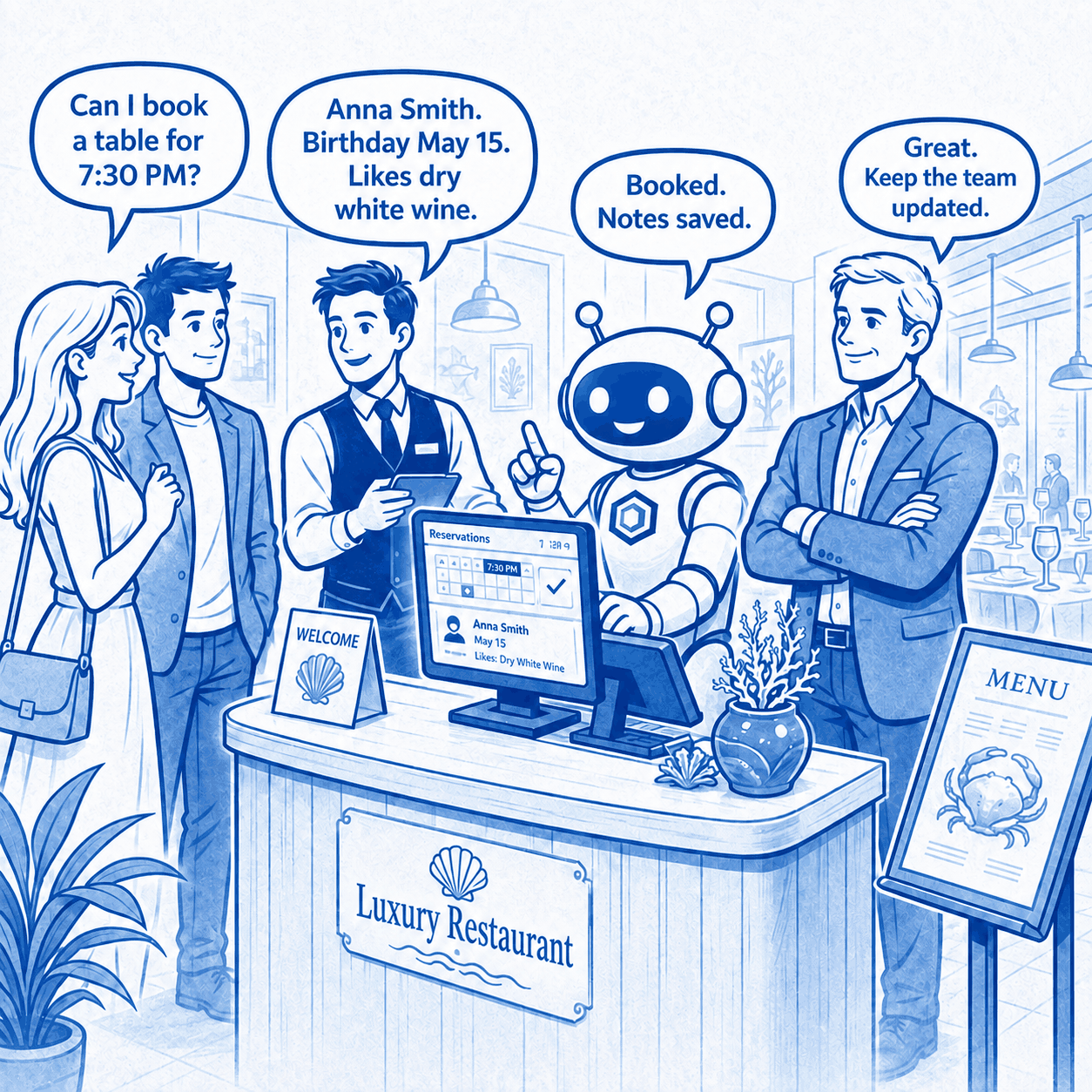
Optimise the restaurant’s key operational processes: speed up staff training and onboarding, reduce the workload on employees handling calls and bookings, minimise manual work with guest reviews, comments and messages, and provide faster, more consistent 24/7 service. This required automating repetitive tasks and connecting them to the restaurant’s existing CRM, Syrve, telephony and digital channels without rebuilding its current infrastructure.

The goal of the project is to provide 24/7 multilingual support for security system users via the website, mobile app, and phone lines. Binom Technical Support independently consults on device operation, assists with password recovery, and identifies types of malfunctions from photos. The system automates routine request handling and integrates with a ticketing system to escalate complex incidents to live specialists.

Create an Artificial Intelligence that will respond to client’s text and phone queries 24/7 in the most accurate and helpful way. Clients base of 3 million users.