
How a delicatessen chain in Warsaw united its website, social media and offline stores under one AI seller that advises customers 24/7 in any language.
- Client: Dobrze Wiedzieć Delikatesy
- Role: Binom Online & Retail Seller
- Launch: 3 days per project, 15 minutes of owner time
- Author: Vladimir Winner
Timeline and Budget
- Project timeline: 3 days.
- Owner time: 15 minutes.
- Binom: €65 per month, Middle plan. Above the plan, 5 cents per request, where a request is one processed message.
- Online store adaptation for Product ID: €150 one-time.
- Customer service customization: €30.
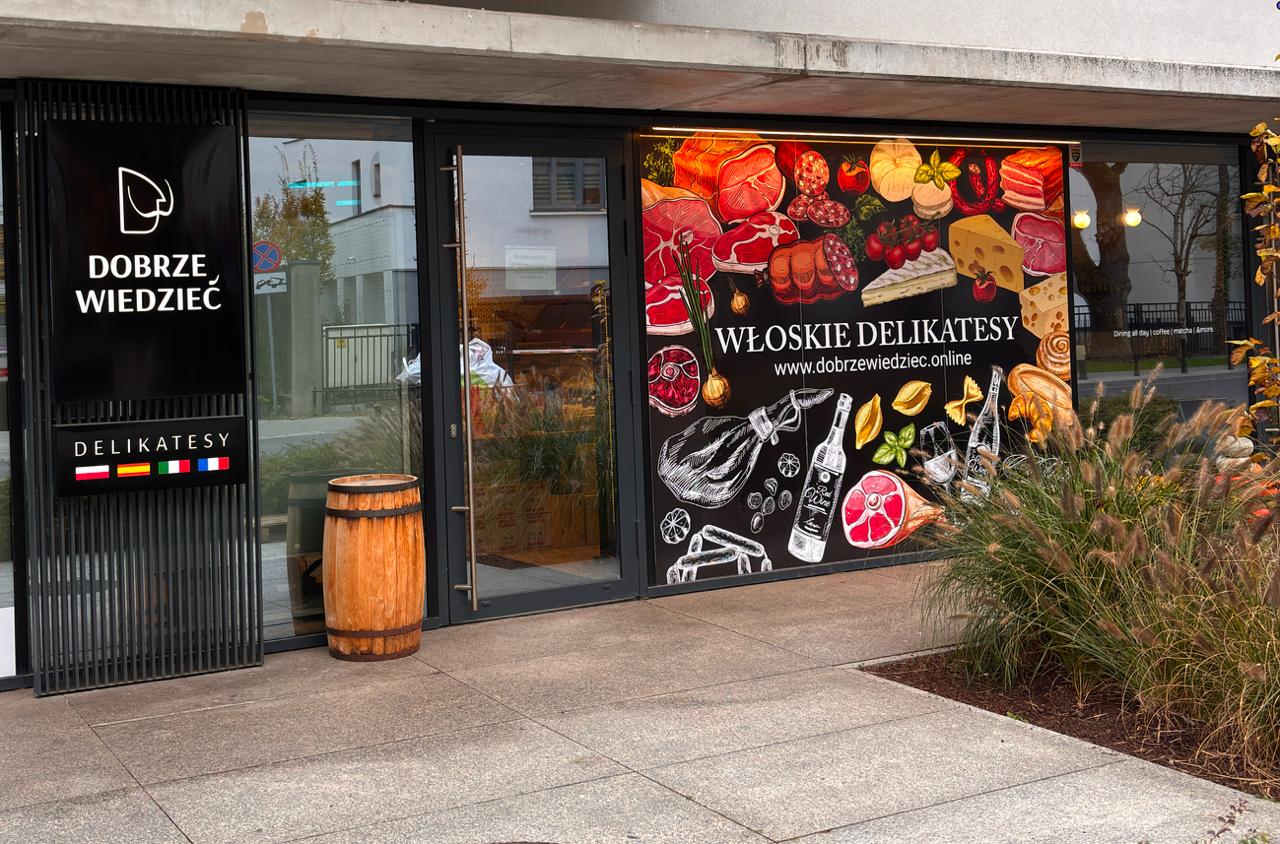
Task
Give the customers of a chain of delicatessen stores a personal service of the same quality everywhere they interact with the company: in the online store, on social media, and in the stores themselves. The service must work 24/7, in any language, and not only sell but also advise.
For delicatessen products and wine, advice matters as much as the sale: the customer needs to be told how to use the product, what to pair it with, and how one wine differs from another. Whether they come back for the next purchase depends on it.
Starting Situation
The company had three streams of customers: online store traffic, its social media audience, and visitors to two stores in Warsaw. These were often the same people, but nothing connected them: in each channel the customer started the conversation from scratch, and the company did not know that an offline customer had also been interested in the product on the website, or the other way around.
Why Binom Online & Retail Seller
The solution is based on the Binom Online & Retail Seller role. It already has everything this task needs: simultaneous work on the website, in social media and messengers, as well as a bridge to offline through QR codes. The salesperson's behavior, instructions and sales logic are already built into the role, so there was no need to configure them from scratch.
What Was Done
Launch in 15 Minutes
The links to the online store and social media were uploaded to the dashboard. Based on them, Binom studied the assortment and subject matter, and obtained the store addresses and contacts.
Languages, Branding and Tone of Voice
Polish is the main language, and multilingual support is enabled: Binom starts the conversation in Polish and replies in whatever language it is addressed in. Binom's colors are automatically adjusted to the brand. The tone of voice, friendly and professional, is set directly in the dialogue with Binom in the dashboard.
Voice, Voice Messages and Text
Three communication modes are connected: real-time voice conversation, voice messages, and text chat.
Google Feed: Products and Prices Always Up to Date
The company's advertising agency provided a link to the Google feed. Now Binom's products, prices and availability match what customers see in Google and Facebook ads, and update automatically, without manual price list uploads.
Testing and Priority Setup
Binom was tested on the Public Page in the dashboard, and then in the same dashboard its communication style and product recommendation order were refined: Binom offers products in a sequence that is interesting to the customer and beneficial to the company.
Widget on the Website
The site has a floating chat widget installed. Customers can talk to Binom by voice, and the products being discussed appear right in the chat window. In the chat, customers can place an order or leave their contact details. Binom passes them on to the dashboard and CRM, and sends a notification to Telegram.
Two Telegram bots
The first bot is for customers: those who are used to Telegram get the same consultation there and can place an order. Orders go to the dashboard and CRM. The second bot is for staff: it receives notifications about new orders, dissatisfied customers, and requests to get in touch.
Product ID: Binom knows which product the customer is looking at
The online store developer added the Product ID of each product to the page address in an hour and a half. The widget and iFrame read it and start the conversation about the product the customer is currently viewing.
A salesperson on the product page
A chat window (iFrame) is built into the design of every product card. Binom sees the product and offers to discuss it, answer questions, and suggest what to pair it with. It works like a salesperson on the shop floor who walks up and says: good choice, I can help if you need anything.
Social media: comments, Messenger and Direct
The company is active on Facebook and Instagram, so Binom replies to comments: it understands the meaning of a post, its context, and the flow of the discussion, and it has separate instructions for comments. Binom is also connected to Facebook Messenger and Instagram Direct. On Instagram, customers often send a screenshot with the question "do you have this?" Binom finds the product in the price list by its image and offers it or a similar alternative.
A bridge to offline: QR codes in stores
A merchandising module has been integrated: Binom automatically generates a unique QR code for each product, inviting customers to chat with an AI advisor. These QR codes can be placed on price tags, shelves, products, and purchase packaging.
When a customer scans the code, they immediately open a mobile chat focused specifically on that item. Binom can share the product's backstory, explain its features, suggest how to use it, recommend pairings, or offer alternatives. This assists international shoppers, helps out when store staff are busy, and allows the salesperson themselves to quickly pull up product details. If the QR code is placed on the purchase packaging, the conversation with Binom can be continued seamlessly at home.
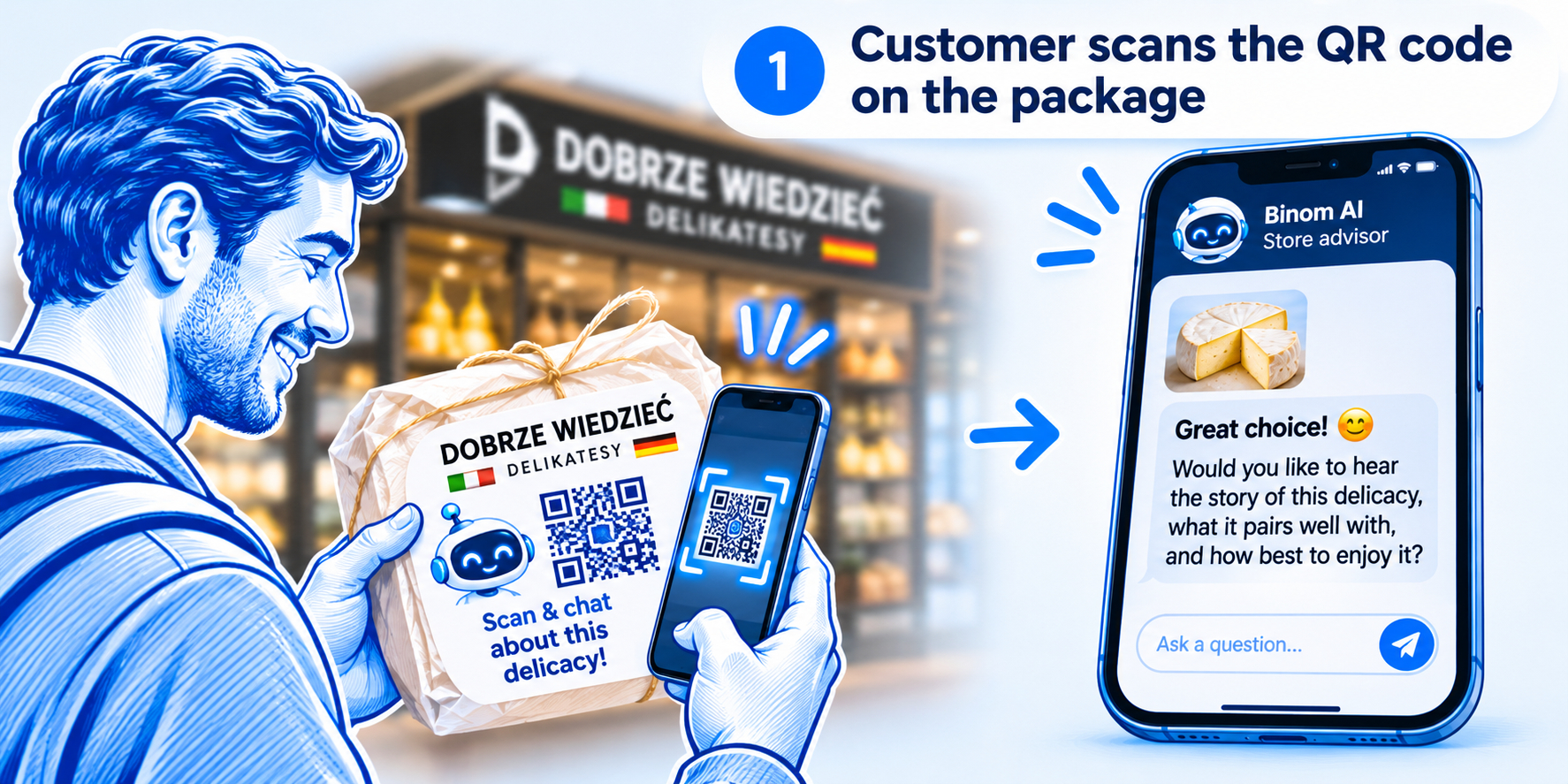
However, the QR code solves yet another task: it turns offline shoppers into a measurable online audience.
Upon scanning the QR code, the Product ID is identified and a digital event is recorded, which can be passed to advertising analytics, Meta Pixel, and GTM. As a result, the store acquires an audience of real people who have physically interacted with specific products.
Using this audience, the store can build Lookalike Audiences and run targeted ads directed at individuals with similar profiles living nearby on adjacent streets. This makes it possible to attract neighbor-buyers who might walk right by without knowing the store exists.
Thus, a closed-loop cycle is created:
offline buyer → QR code → Product ID + digital audience → Lookalike → local advertising → new store visitors → new QR interactions.
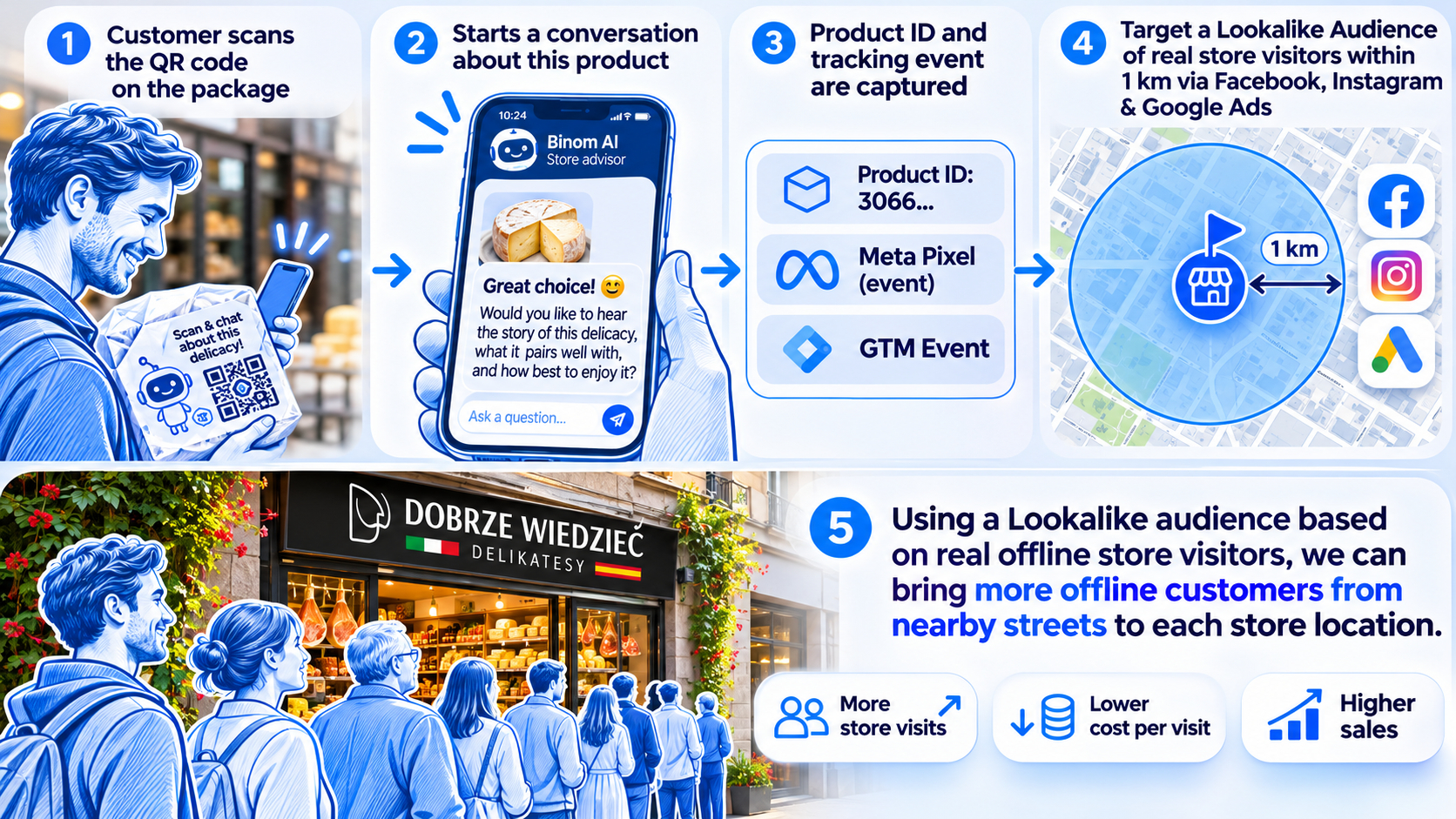
The more real buyers interact with the QR codes, the more data the store gathers to build a relevant local audience.
Instead of expensive broad-reach campaigns, the advertising learns from the actual behavior of the store's real customers, which lowers the cost of acquiring new visitors and boosts offline traffic.
Conversation partner mode
Conversation partner mode has been expanded for delicatessen and wine: in voice chat, customers can talk with Binom about food pairings, where products come from, and traditions of how they are enjoyed.
Remarketing with customer consent
When a customer follows a QR code and agrees to data processing, the information is passed to Google Tag Manager. The company's marketing team sees which product the person was interested in at the store, and can remind them about it or offer an alternative in ads.
Results
- 18% Conversion from dialogue to order
- 4 sec Response time 24/7
- ≈1,4 € Cost of processing one order
- The owner understands buyers better. With AI, people are more candid and aren't shy about asking a lot of questions. The company sees what buyers are actually interested in and manages its inventory based on that.
- 24/7 replies in 4 seconds across all channels and in any language.
- 18% of conversations end in an order thanks to consultations, upselling, cross-selling and timely replies.
- About €1.40 per processed order. On average, 5 messages per conversation, at 5 cents per request: €0.25 per conversation. At an 18% conversion rate, one order comes from roughly 5.5 conversations.
- A unified service on the website, in social networks, messengers and in stores.
What's next
The next step: a retention module. With the buyer's consent, the Binom will call and message them on behalf of the company: reminding them when their favorite products are running low, wishing them a happy birthday, and telling them about new arrivals. Everything complies with European Union requirements for data processing and marketing communications.
Roles for this use case
- Binom Online & Retail Seller: sales on the website, in social networks, messengers and in retail via QR codes.
How to set up the same thing
- How to connect the widget to your website
- How to embed the chat in a product card (iFrame)
- How to connect a Telegram bot
- How to connect Facebook Messenger and Instagram
- How to download QR codes for products
- How to upload a price list and product feed
- How to set the tone of voice via Binom Tutor
- How to enable multilingual support
- How to connect a CRM
Updated November 4, 2026